


MBA. Hellen Ruiz Hidalgo
Strategic Communicator
Foreign Trade Observatory (OCEX)
Vice-Rectory for Research - Distance Learning State University (UNED)
On May 12, 2026, the Legislative Assembly approved, in its second debate, the bill for Costa Rica's accession to the Digital Economy Partnership Agreement (DEPA), whose current members are New Zealand, Singapore, Chile, and South Korea.On May 12, 2026, the Legislative Assembly approved, in its second debate, the bill for Costa Rica's accession to the Digital Economy Partnership Agreement (DEPA), whose current members are New Zealand, Singapore, Chile, and South Korea.
At the following link, we share the official text of the Digital Economy Partnership Agreement (DEPA), dated June 11, 2020: https://www.mfat.govt.nz/assets/Trade-agreements/DEPA/DEPA-Signing-Text-11-June-2020-GMT-v3.pdf
Additional documentation related to the DEPA is available at: https://www.mfat.govt.nz/en/trade/free-trade-agreements/free-trade-agreements-in-force/digital-economy-partnership-agreement-depa/depa-text-and-resources
DEPA – Background. The Digital Economy Partnership Agreement (DEPA) is the world's first digital trade agreement. It covers all aspects of the digital economy that drive trade, ranging from the digitalization of import and export procedures to smoother data flows, the promotion of trust in the online environment, and collaboration on digital inclusion and emerging technologies. These objectives are achieved through a set of rules designed to facilitate and enhance the security of commercial transactions for both businesses and consumers who buy and sell goods and services online.
DEPA: Key Strategic Areas in the Digital Economy. DEPA provides a modern framework for cooperation aimed at strengthening digital transformation and facilitating international e-commerce. Its scope benefits a wide range of productive sectors, including start-ups, technology companies, primary producers, and traditional manufacturers. DEPA focuses on creating a secure, interoperable, and innovative digital ecosystem through international standards, best practices, and cooperation mechanisms.
Among its main areas of action are:
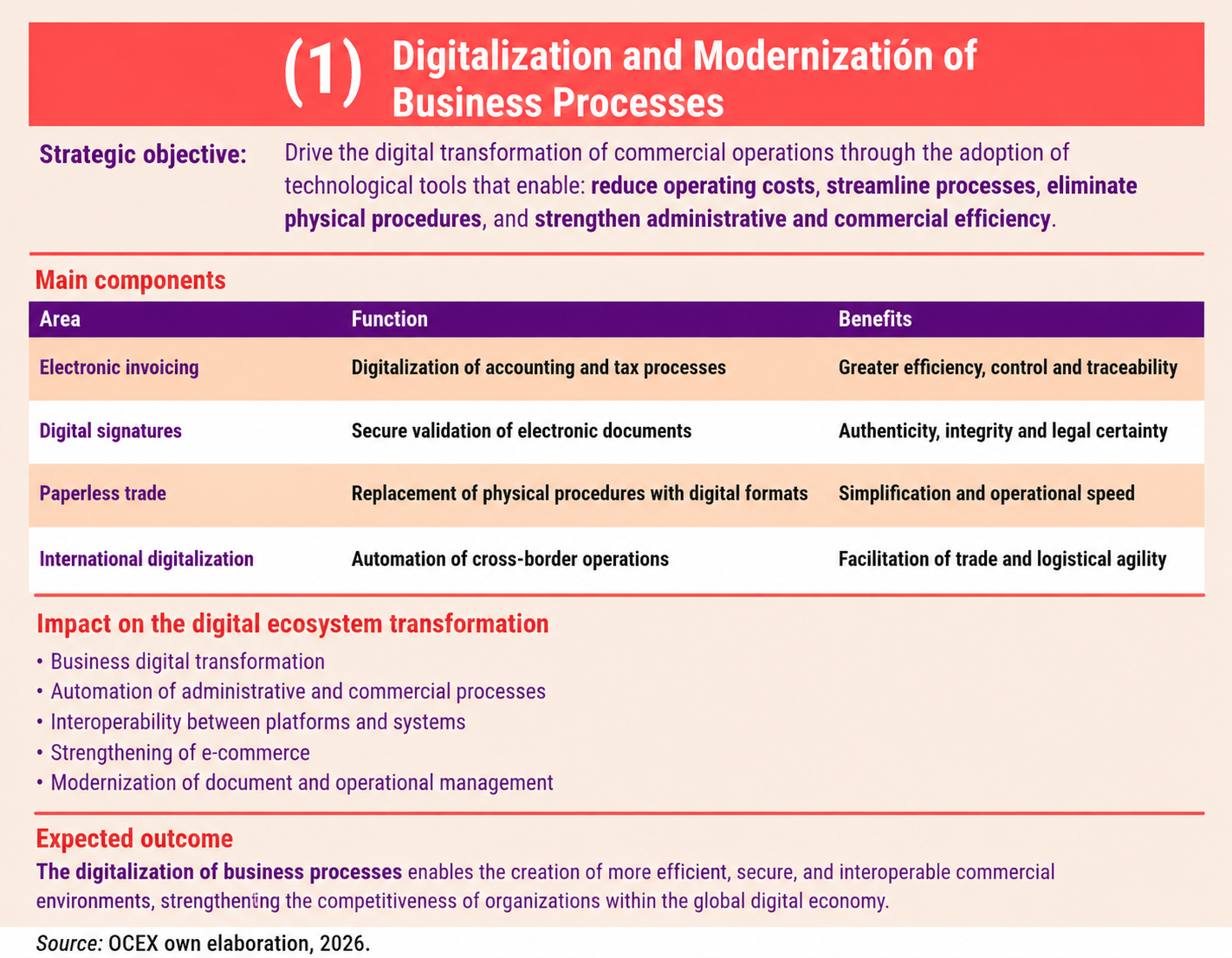
- Digitalization and Modernization of Business Processes
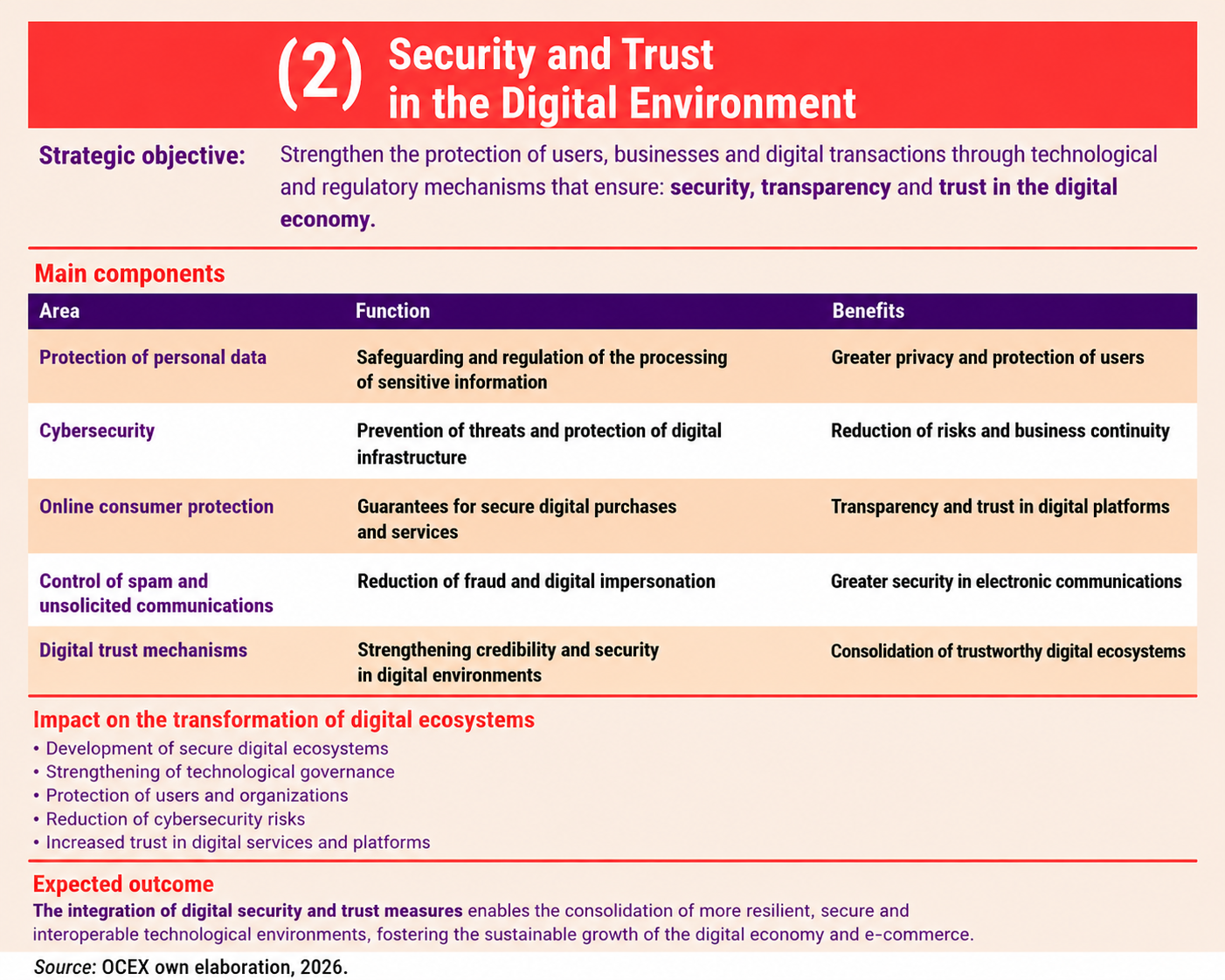
- Security and Trust in the Digital Environment
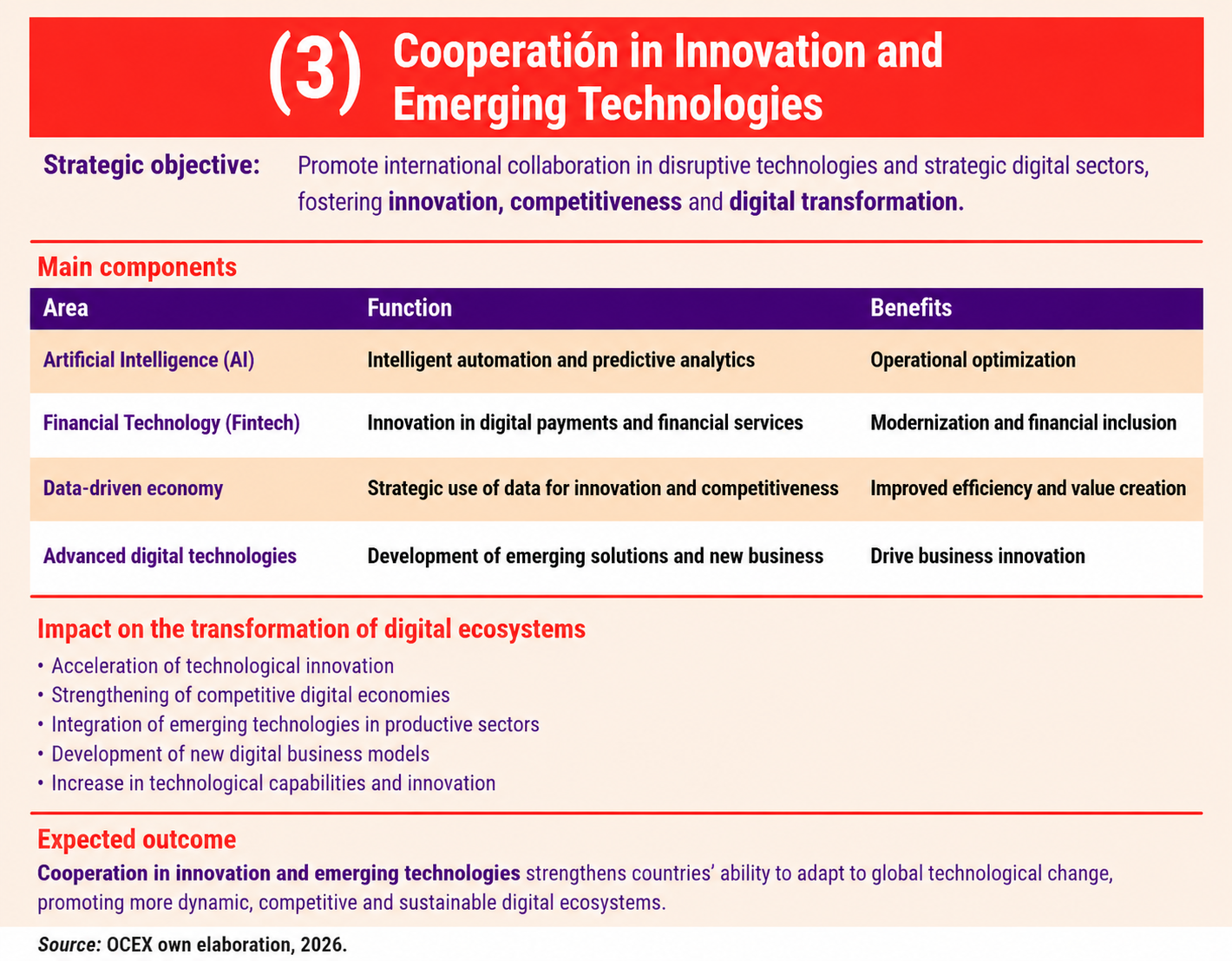
- Cooperation in Innovation and Emerging Technologies
Further details are provided in the following diagrams:
DEPA also incorporates strategic principles aimed at ensuring an open, competitive, and secure digital environment. These include:
- Free Cross-Border Data Flows: Facilitates the international movement of data to enhance service delivery and digital trade.
- Non-Discrimination of Digital Products: Ensures fair and equitable treatment of digital goods and services among the Parties.
- Prohibition of Forced Localization of Technological Infrastructure: Prevents requirements to establish servers or data centers in a specific territory as a condition for conducting business.
- Protection of Digital Identities: Promotes secure, interoperable, and reliable digital identity systems.
- Ethical Governance of Artificial Intelligence: Encourages principles and regulatory frameworks for the responsible, secure, and transparent development and use of AI technologies.
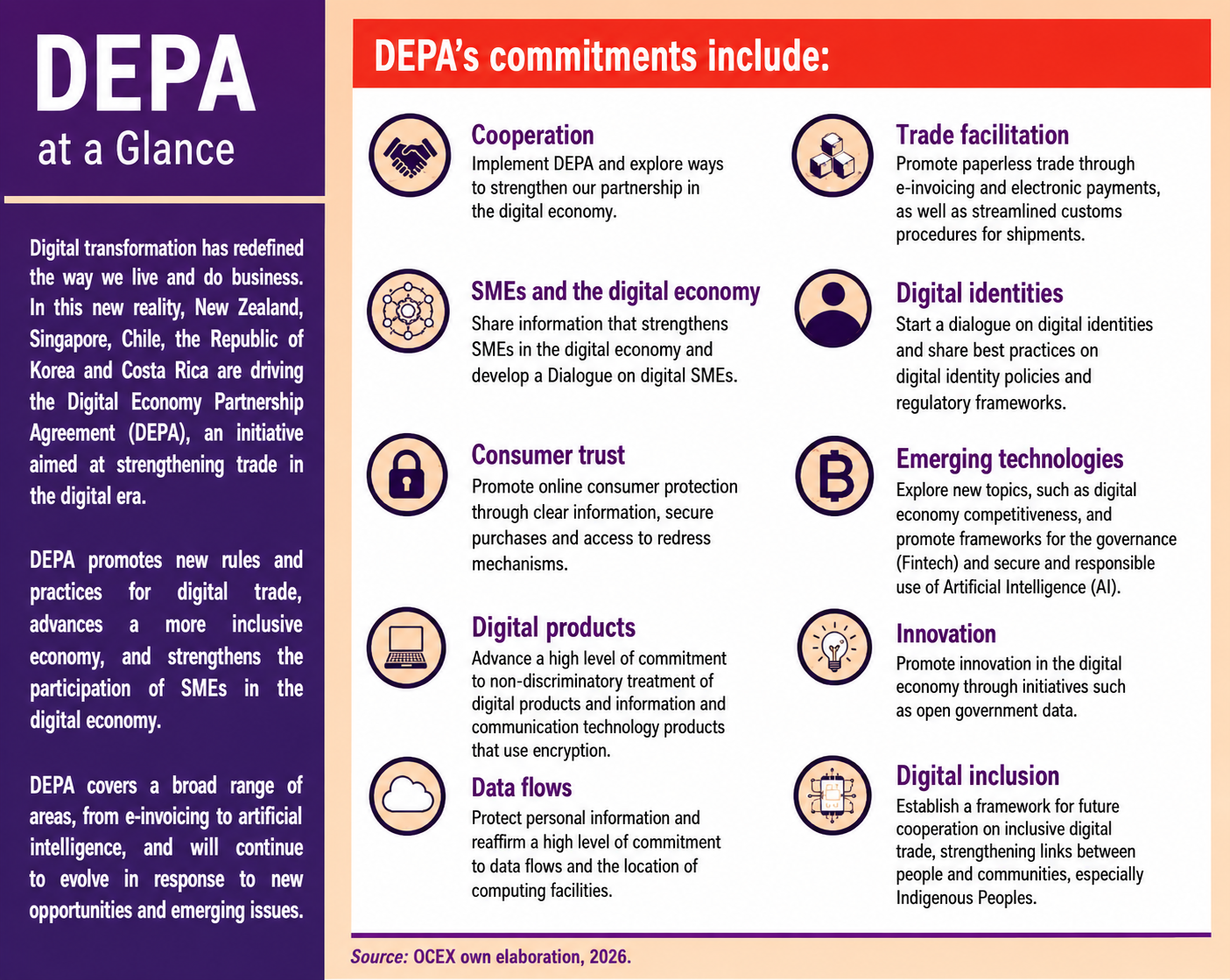
Taken together, DEPA represents one of the most innovative agreements in the field of the digital economy, integrating advanced technological disciplines and cooperation mechanisms that foster competitiveness, innovation, and trust in global digital trade. The following diagram summarizes the commitments included in DEPA:
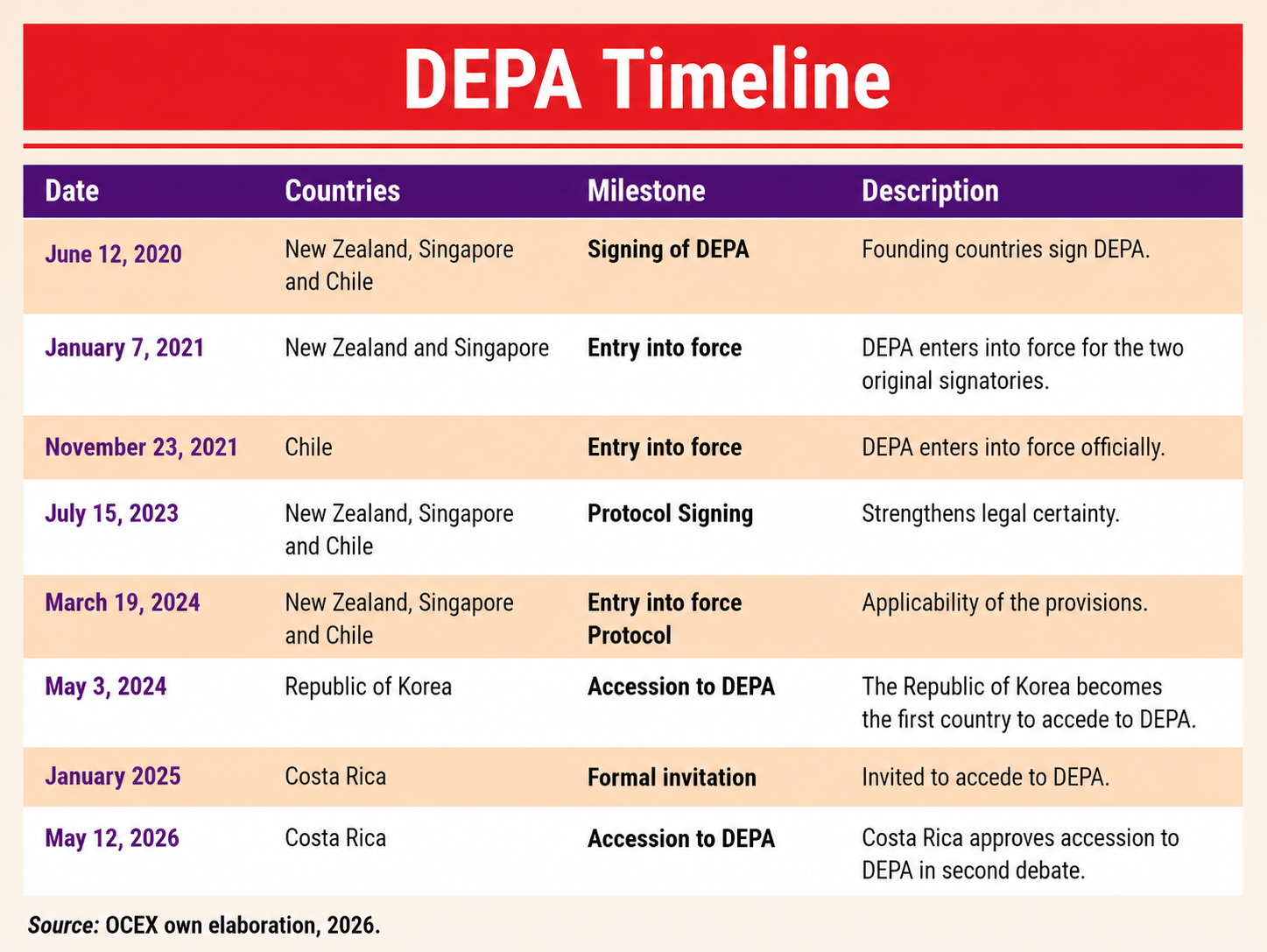
DEPA: Timeline of Key Approval and Accession Milestones of Member Economies. DEPA was established on June 12, 2020, with the signing of the Agreement by New Zealand, Chile, and Singapore during a virtual ceremony. It entered into force on January 7, 2021, for New Zealand and Singapore, and on November 23, 2021, for Chile.
The Protocol to the Digital Economy Partnership Agreement was signed on July 15, 2023. The Protocol strengthens legal certainty and enhances the enforceability of key DEPA provisions for New Zealand’s digital exporters and for economies seeking accession to the Agreement. It entered into force on March 19, 2024.
DEPA currently has five Parties: New Zealand, Chile, and Singapore, the original signatories, together with the Republic of Korea, which officially joined in May 2024. In January 2025, Costa Rica was formally invited to accede to DEPA and completed its accession process in May 2026. Peru received a formal invitation to join the Agreement in January 2026.
DEPA’s Linkages with International Digital Economy Forums. DEPA complements the work being carried out on digital economy issues in international forums such as the World Trade Organization (WTO), the Asia-Pacific Economic Cooperation (APEC), and the Organization for Economic Co-operation and Development (OECD). New Zealand has also drawn upon DEPA as a model for its most recent trade agreements, including the New Zealand–European Union Free Trade Agreement and the New Zealand–United Kingdom Free Trade Agreement.
|
DEPA’s Linkages with International Digital Economy Forums |
||
|
Organization / Agreement |
Subject |
Official Link |
|
World Trade Organization (WTO) |
E-commerce and Digital Trade |
|
|
Organization Asia-Pacific Economic Cooperation (APEC) |
Digital Economy and Transformation |
|
|
Economic Co-operation and Development (OECD) |
AI, Digital Economy, and Governance |
|
|
New Zealand, European Union Trade Agreement |
NZ–EU Free Trade Agreement |
|
|
New Zealand, United Kingdom Trade Agreement |
NZ–UK Free Trade Agreement |
|
|
Ministry of Trade, New Zealand |
Official Information on DEPA |
|
|
Source: Prepared by OCEX, 2026. |
||
DEPA: A Strategic Opportunity for Costa Rica. In January 2025, Costa Rica received a formal invitation to accede to DEPA. On May 12, 2026, the Legislative Assembly approved, in its second debate, the bill authorizing Costa Rica’s accession to the Digital Economy Partnership Agreement (DEPA). The implementation of DEPA is a joint effort led primarily by two government institutions: The Ministry of Foreign Trade (COMEX) and the Ministry of Science, Innovation, Technology and Telecommunications (MICITT). Both institutions spearheaded the promotion and defense of the Agreement before the Legislative Assembly and have presented DEPA as a key component of Costa Rica’s national strategy for digital transformation and international trade. In particular, COMEX leads initiatives related to digital trade, international economic integration, and investment attraction. MICITT, in turn, oversees areas related to innovation, digital governance, artificial intelligence, cybersecurity, and emerging technologies.
An Attractive Value Proposition for Costa Rica. Costa Rica has consolidated its position as an open economy, successfully establishing itself as a platform for exporting high-quality goods and services to major global markets.
DEPA is particularly relevant to the services sector, an area in which Costa Rica has excelled. In 2023, services accounted for 45% of the country’s total exports. These exports have also undergone a significant process of sophistication, with modern services—such as information and communication technology (ICT) services, including software development—and high value-added business services—such as accounting, finance, back-office operations, architecture, engineering, and legal services—representing 57% of total service exports.
According to data from the Central Bank of Costa Rica, 43.4% of service exports in 2022 were supplied through information, communication, and technology platforms. In addition, Costa Rica maintains a foreign direct investment (FDI) attraction strategy that offers a highly competitive value proposition for technology-based companies seeking to establish operations in the country.
In a press release issued by COMEX on May 13, 2026, following the Legislative Assembly’s approval of DEPA, the Ministry noted that: “Services currently account for 46% of Costa Rica’s total exports, and nearly half of these exports are conducted through digital channels.”
Through its accession to DEPA, Costa Rica further strengthens its international standing as a reliable partner and a committed participant in the development of the digital economy. The country’s commitment to a modern, forward-looking trade agenda reinforces its position and influence in the global digital landscape. DEPA is a pioneering international initiative that seeks to facilitate digital trade and the digital economy while promoting innovation and economic growth in the digital environment.
The Minister of Foreign Trade, Indiana Trejos, emphasized that: “This is a strategic step toward strengthening Costa Rica’s integration into the global digital economy, helping to create more favorable conditions for digital trade, investment attraction, and the development of talent and emerging technologies.”
Likewise, the Minister of Innovation, Science, Technology and Telecommunications, Paula Bogantes Zamora, stated that: “Costa Rica’s accession to DEPA represents a milestone for the country and sends a clear signal about our vision: an open, innovative economy prepared to compete in the digital age.”
DEPA Consolidates Costa Rica’s Trade and Digital Transformation Agenda. Through DEPA, Costa Rica advances toward a modern framework of international rules and cooperation. In this context, legislative approval of the Agreement will enable the country to implement a contemporary framework that facilitates trade in digital products and services, provides greater legal certainty for businesses and consumers, and promotes broader participation by individuals and SMEs in the global digital economy.
New Zealand Has Led International Outreach Regarding Costa Rica’s Accession to DEPA. International references and official communications concerning Costa Rica’s accession to DEPA have already emerged, with New Zealand being one of the most active countries in promoting and publicizing the process.
The following examples illustrate the positive international recognition and visibility that Costa Rica has gained through its accession to DEPA:
- The New Zealand Ministry of Foreign Affairs and Trade issued an official statement announcing the substantial conclusion of negotiations for Costa Rica’s accession to DEPA, highlighting that the country met the Agreement’s high standards and demonstrated strong commitments in areas such as electronic invoicing, consumer protection, and cross-border data transfers.
- The official website of New Zealand’s Ministry of Foreign Affairs and Trade also lists Costa Rica among the economies that have been formally invited to accede to DEPA since January 2025.
- COMEX Website. Relevant Documents Section. Digital Economy Partnership Agreement (DEPA). Available at: https://www.comex.go.cr/tratados/depa/?utm
- International media outlets and policy analyses have emphasized that Costa Rica would become the first Central American country to join DEPA, widely recognized as the world’s first trade agreement focused exclusively on the digital economy.
- Regional coverage has also emerged in DEPA member economies, including Chile, where trade authorities have noted that Costa Rica’s accession will help expand advanced digital trade standards across Latin America.
Furthermore, from the perspective of international trade policy, Costa Rica’s accession has been regarded as strategically significant because it:
- Consolidates the country’s position as an emerging digital economy;
- Strengthens its integration into global digital value chains; and
- Enhances its ties with highly digitalized economies such as Singapore, Chile, the Republic of Korea, and New Zealand
At the following link, we share the official text of the Digital Economy Partnership Agreement (DEPA), dated June 11, 2020:https://www.mfat.govt.nz/assets/Trade-agreements/DEPA/DEPA-Signing-Text-11-June-2020-GMT-v3.pdf
Additional documentation related to the DEPA is available at: https://www.mfat.govt.nz/en/trade/free-trade-agreements/free-trade-agreements-in-force/digital-economy-partnership-agreement-depa/depa-text-and-resources
References consulted:
- Sitio Web. COMEX y MICITT celebran la aprobación del Acuerdo de Asociación de Economía Digital en segundo debate por parte de la Asamblea Legislativa. Mayo de 2026. En: https://www.micitt.go.cr/el-sector-informa/comex-y-micitt-celebran-la-aprobacion-del-acuerdo-de-asociacion-de-economia
- Sitio Web de COMEX. Sala de Prensa. En: DEPA consolida la agenda de comercio y transformación digital del país, por lo que este paso en el Congreso permitirá avanzar en un marco moderno de reglas y cooperación internacional.
- Sitio Web de PROCOMER. Sala de Prensa. En: Exportaciones totales de Costa Rica crecen un +11% en el 2025
- Sitio Web oficial del Acuerdo de Asociación de Economía Digital (DEPA). En: https://www.mfat.govt.nz/depa
- Sitio Web del Ministerio de Relaciones Exteriores y Comercio de Nueva Zelanda. Sección recursos relacionados con el DEPA, en: https://www.mfat.govt.nz/en/trade/free-trade-agreements/free-trade-agreements-in-force/digital-economy-partnership-agreement-depa/depa-text-and-resources
- Sitio Web del Ministerio de Relaciones Exteriores y Comercio de Nueva Zelanda. Descripción general de DEPA. En: https://www-mfat-govt-nz.translate.goog/en/trade/free-trade-agreements/free-trade-agreements-in-force/digital-economy-partnership-agreement-depa/overview?_x_tr_sl=en&_x_tr_tl=es&_x_tr_hl=es&_x_tr_pto=tc
- Sitio Web OCDE. Temas en materia digital. En: https://www.oecd.org/en/topics/digital.html Panorama de la Economía Digital. En: https://www.oecd.org/es/publications/perspectivas-de-la-ocde-sobre-la-economia-digital-2017_9789264302211-es.html?utm_
- Sitio Web OMC. Comercio electrónico y otras tecnologías digitales. En: https://www.wto.org/spanish/tratop_s/ecom_s/ecom_s.htm?utm_
- Sitio Web APEC. APEC Internet and Digital Economy Roadmap (AIDER). En: APEC – Grupo Directivo sobre Economía Digital
- Sitio Web Información Oficial. Acuerdo de Libre Comercio Nueva Zelanda–Unión Europea. En: Acuerdo de Libre Comercio Nueva Zelanda–Unión Europea
- Sitio Web Información Oficial. Acuerdo de Libre Comercio entre Nueva Zelanda y el Reino Unido. En: Acuerdo de Libre Comercio Nueva Zelanda–Reino Unido
- Sitio Web del Ministerio de Relaciones Exteriores y Comercio de Nueva Zelanda. Información Oficial sobre el DEPA. En: Acuerdo de Asociación de Economía Digital (DEPA) – MFAT